Advertisement
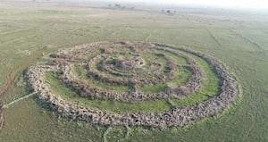

The newly discovered sites all share a similar design: large circular structures, between approximately 50 to 250 meters in diameter, built with stones taken from local basalt fields.
The stone circles of Rujm el-Hiri, nicknamed “Israel’s Stonehenge” or “Gilgal Refaim,” are not the only ones of its kind, according to a new study by Ben-Gurion University of the Negev (BGU) researchers.
By using advanced satellite imagery and remote sensing technology to survey areas previously inaccessible, BGU researchers have identified at least 28 other sites within 25 kilometers of Rujm el-Hiri that were not previously known.
The findings, recently published journal PLOS One, suggest that Rujm el-Hiri was not a singular, isolated monument, but rather an “elaborate example of a widespread architectural tradition integrated into the social and economic systems of the proto-historic Levant.”
Rujm el-Hiri was first discovered in the Golan Heights in 1968, and has been dated to approximately 3,500 and 6,500 years ago. It is made of a central cairn encircled by multiple concentric basalt stone rings, spanning for over 150 meters in diameter.
Satellite imagery revealed that the newly discovered sites share a similar design: large circular structures, between approximately 50 to 250 meters in diameter, built with stones taken from local basalt fieldstones.

Site part of a broader social, economic system
The discovered structures contain circular walls and internal partitions, often located near seasonal water sources and integrated into agricultural land use, revealing how ancient populations managed their resources and moved across the area.
Further, researchers believe the stone circles may have been multi-purpose, serving as ritual gathering places, territorial markers, or assembly sites for ancient herding communities, adding to earlier theories of Rujm el-Hiri being a burial site or astronomical observatory.
According to Dr. Michal Birkenfeld of BGU’s Department of Archaeology, the circles “invite a reinterpretation of significant proto-historic monuments in the region, recognizing them as integral parts of broader social and economic systems.”
"Our analysis may have implications for previous interpretations of Rujm el-Hiri's function," she concluded. "While traditional archaeological methods remain essential, this landscape-based perspective allows us to reach a fuller understanding of these monuments within our shared human past."
LATEST POSTS
- 1
 Scientists uncover an ant assassination scheme that helps a parasitic queen rise to power
 - 2International issues on the agenda as Frances's Macron visits China
- 3The most effective method to Alter Your Kona SUV for Greatest Solace and Comfort
- 4Deadly Switzerland ski resort fire was likely started by sparklers attached to champagne bottles, officials say
- 5Pick Your Favored kind of soup


- Safeguarding Your Senior Protection Against Extortion and Tricks.
- Little Italy Mercato brings fresh food and community to downtown San Diego
- A Colombian city swaps iconic horse buggies for electric carriages amid animal welfare concerns
- From Educational Loans to Obligation Free: Independence from the rat race Accomplished
- SpaceX's 1st 'Version 3' Super Heavy Starship booster buckles under pressure during initial tests
- Administrative building in Sharjah region targeted by Iranian drone, UAE authorities announce
- Millions in JDM Exports and Exotic Supercars Are Currently Trapped at Sea
- Indoor Drinking Fountains: Famous Home Advancements during the Pandemic
- Support Your Wellness: 20-Minute Home Exercises That Work