Advertisement
When you buy through links on our articles, Future and its syndication partners may earn a commission.

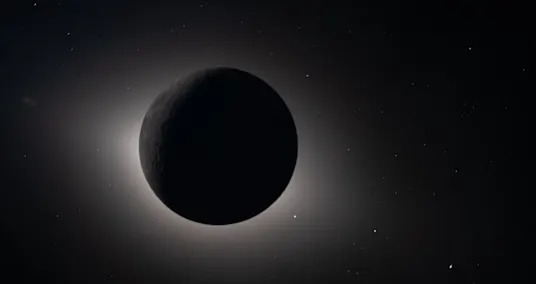
NASA's Artemis 2 astronauts have witnessed one of the rarest sights in spaceflight history — a total solar eclipse from beyond the moon.
The event unfolded yesterday (April 6) as the Orion spacecraft looped around the far side of the moon. This trajectory placed the crew in the right place at the right time to see the moon completely block the sun for about 53 minutes, which is far longer than the maximum period of totality for eclipses seen from Earth.
But it wasn't just the duration that made this eclipse extraordinary; it was the view.
NASA astronaut Victor Glover described the scene unfolding as the sun vanished behind the lunar disk.
"This continues to be unreal. The sun has gone behind the moon and the corona is still visible. It's bright and creates a halo almost around the entire moon," Glover said.
As darkness fell, another phenomenon quickly emerged. "When you get to the Earth side, the earthshine has already shown … almost seconds after the sun sets behind the moon, you can see earthshine," he added.
From Orion's windows, the crew was able to make out the faint glow of sunlight reflected off Earth, while stars and planets appeared in the background. The moon itself became a stark silhouette: "This black orb out in front of us," as Glover described it, edged by the glowing solar corona.

Though a rare sight, it's not the first time a solar eclipse has been viewed from lunar realms. The Apollo astronauts, who orbited the moon rather than flew by it (as Artemis 2 did), also saw solar eclipses, NASA's Kelsey Young, Artemis science flight operations lead, said during a press conference on Saturday (April 4).
The eclipse marks just one highlight in an already historic mission. Artemis 2 is the first crewed journey to the moon since Apollo 17 and has already set a new distance record for human spaceflight.
Following their impressive lunar flyby, the astronauts are now heading back toward Earth and are expected to splashdown on Friday (April 10) off the coast of San Diego.
LATEST POSTS
- 1
 Top notch Feasting: A Manual for Worldwide Acclaimed Eateries
 - 2Danish warship sunk by famed British admiral discovered after 225 years
- 3Geminid shooting stars: One of 2025's most exciting meteor showers begins tonight
- 4Israel approves death penalty law for Palestinians convicted of attacks
- 5Starbucks' new 'Bearista' cup is causing a stir — and is being listed on eBay for $600





- Monetary Versatility: Get ready for Life's Unforeseen Difficulties
- Who is behind Al-Majd, the Israeli-linked evacuation group sending Gazans to South Africa?
- Watch Blue Origin's huge New Glenn rocket ace its epic landing on a ship at sea (video)
- Chris Noth responds to backlash after seemingly shading 'Sex and the City' costar Sarah Jessica Parker: 'It is not news'
- Greenland’s melting ice and landslide-prone fjords make the oil and minerals Trump is eyeing dangerous to extract
- Fundamental Home Exercise center Hardware: Amplify Your Exercises
- Grasping the Commencement of Criminal Cases: An Extensive Outline
- Figure out What Shift Differentials Mean for Your General Attendant Compensation
- German journalists' union condemns attack on reporters in village